 By
By End of tenancy cleaning vs deep cleaning, which one do you actually need?
Both services are thorough, but they are designed for different situations. Here is how to choose the right clean for your Edinburgh property.
Get free quote on WhatsAppIn this guide
End of tenancy cleaning vs deep cleaning, which one do you actually need?
People ask me this more than almost any other cleaning question.
They are moving out of a flat, want to reset their home properly, or are unsure whether to book an end of tenancy clean or a deep clean.
Sometimes they assume the services are the same thing with different names.
They are not.
End of tenancy cleaning and deep cleaning are two distinct services designed for two different situations. Booking the wrong one can create problems that are entirely avoidable.
Here is the difference from the perspective of someone who has carried out both services hundreds of times across Edinburgh.
What end of tenancy cleaning actually is
An end of tenancy clean is a specific service with a specific purpose.
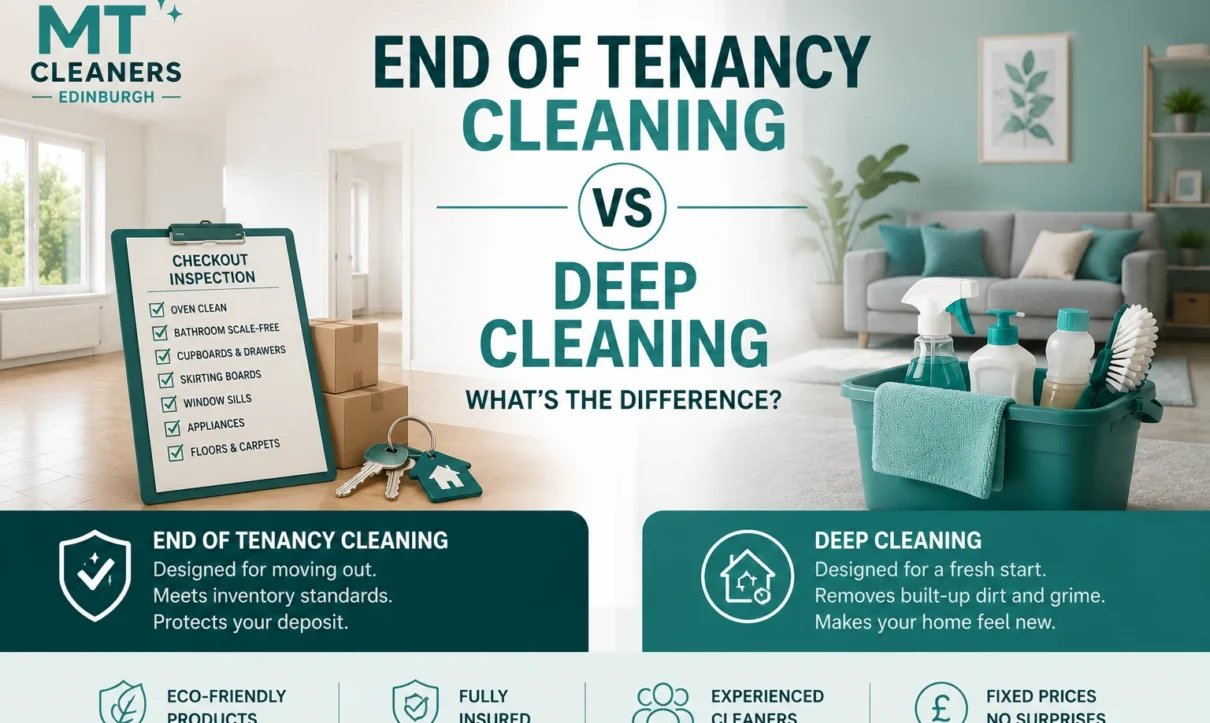
It is designed to return a rental property to the condition recorded in the move-in inventory so that the tenant can recover their deposit and the landlord can prepare the property for the next tenant.
The defining characteristic of an end of tenancy clean is that it is measured against a documented standard: the inventory produced at the beginning of the tenancy.
Everything the checkout clerk photographs during the inspection may be compared with the move-in record. The clean therefore needs to meet or improve upon that benchmark.
This gives end of tenancy cleaning a different discipline from other types of cleaning.
It is not primarily about making the property feel comfortable for the person living there. It is about meeting an inspection standard that a letting agent, landlord, or independent inventory clerk may assess using photographs and written documentation.
Inspection points that matter most
- The oven interior, racks, hob, and extractor fan
- Bathroom taps, showers, screens, grout, and limescale
- The inside of kitchen cupboards and drawers
- Skirting boards, window sills, and ledges
- The washing machine seal and drum
- Wardrobes, shelving, and other storage spaces
These are the areas that appear on checkout checklists and the places many DIY cleans miss.
Our end of tenancy cleaning service across Edinburgh is built specifically around this inspection checklist.
Our guide on how to prepare for an end of tenancy inspection in Edinburgh explains what happens during the inspection and how to prepare for it.
What deep cleaning actually is
A deep clean is a thorough, intensive clean that goes significantly further than regular domestic cleaning.
Unlike an end of tenancy clean, it is not measured against a move-in inventory or a checkout inspection standard.
The purpose of a deep clean is to reset a property and address the gradual build-up that weekly or fortnightly cleaning does not reach.
Areas commonly covered during a deep clean
- Behind and underneath movable furniture
- Inside ovens and other kitchen appliances
- Grout lines, tiles, taps, and accumulated limescale
- High surfaces, vents, ledges, and neglected corners
- Skirting boards, doors, switches, and handles
- Areas skipped during ordinary maintenance cleaning
People book deep cleans for many different reasons.
A deep clean is thorough by design, but it is not controlled by an external inventory benchmark.
The measure of success is how clean, fresh, and functional the property feels for the person living there.
Our deep cleaning service across Edinburgh follows this full reset approach throughout every room.
Where the two services overlap
Both services cover a lot of the same physical areas.
A thorough clean is a thorough clean regardless of the service name.
The difference is the framework around the work.
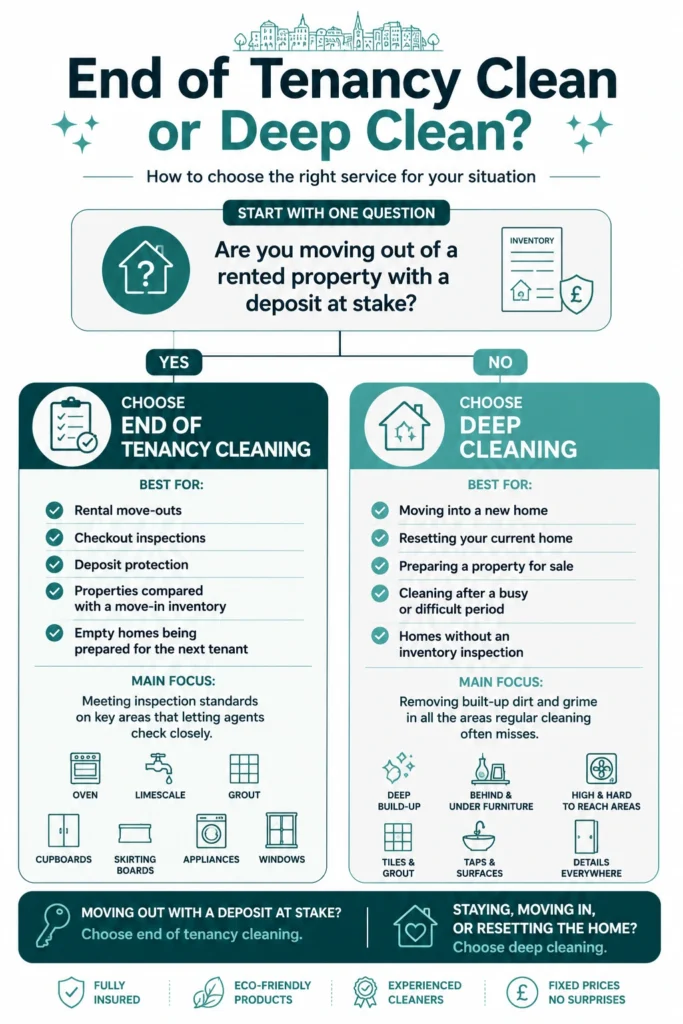
An end of tenancy clean follows a checklist based on what letting agents and inventory clerks inspect. A deep clean follows a framework based on what makes a lived-in home genuinely clean after a period of ordinary maintenance.
From the outside, the two services can look similar.
The distinction matters when booking because a deep clean may produce a thorough result without the specific inspection focus that determines whether a tenant recovers their deposit.
End of tenancy cleaning vs deep cleaning
| End of tenancy cleaning | Deep cleaning |
|---|---|
| Designed for tenants moving out | Designed to reset a lived-in property |
| Measured against the move-in inventory | Not measured against an external document |
| Focused on checkout inspection points | Focused on neglected build-up throughout the home |
| Supports deposit recovery | Improves cleanliness, comfort, and presentation |
| Usually completed after the property is emptied | Can be completed while the property remains occupied |
| Best for rental move-outs and re-letting | Best for move-ins, property sales, and home resets |
How to decide which one you need
The decision is simple once you understand what separates the two services.
Book an end of tenancy clean if:
- You are moving out of a rental property
- Your deposit depends on the checkout result
- A letting agent or inventory clerk will inspect the property
- You need the property cleaned against the move-in inventory
- You want inspection points handled systematically
Book a deep clean if:
- You are staying in your current home
- You are moving into a new property
- You are preparing a property for sale
- You want to reset the home after a busy period
- There is no tenancy inspection or inventory comparison involved
Moving out with a deposit at stake means end of tenancy cleaning. Staying, moving in, selling, or resetting the space means deep cleaning.
What both services cost in Edinburgh
Prices are fixed according to the size and condition of the property.
| Property size | Starting price |
|---|---|
| Studio flat | From £90 |
| 1-bedroom flat | From £120 |
| 2-bedroom house | From £150 |
| 4-bedroom house | From £180 |
| 5-bedroom house or larger | From £200+ |
All prices are fixed, and you will know the full cost before we arrive. We use eco-friendly products that are safe around children and pets, and we are fully insured on every job.
Get free quote on WhatsAppHow to book
Send us a WhatsApp message with your property size and explain what you need.
We will reply quickly, confirm whether an end of tenancy clean or deep clean fits your situation, and secure your preferred cleaning slot.
Visit mtcleaners.co.uk or tap below.
Not sure which cleaning service to book?
Tell us your property size and situation. We will recommend the right service and send a clear fixed quote on WhatsApp.
Get free quote on WhatsAppFAQs about end of tenancy cleaning vs deep cleaning
What is the difference between deep cleaning and end of tenancy cleaning?
End of tenancy cleaning is measured against the inventory standard from the beginning of the tenancy and is designed for a letting agent or checkout inspection. Deep cleaning is a thorough property reset without an external inventory benchmark. Both services are intensive, but their purpose and focus are different.
Are regular cleaning and deep cleaning different?
Yes. Regular cleaning maintains visible surfaces and frequently used areas between visits. Deep cleaning addresses build-up that regular cleaning does not usually reach, including inside appliances, grout lines, areas behind furniture, vents, and surfaces that accumulate dirt over several months.
Which is more painful, a root canal or deep cleaning?
This question refers to dental treatment rather than property cleaning. Experiences vary between patients and procedures, so a dentist is the right person to ask for guidance about discomfort, anaesthetic, and treatment options.
Should landlords deep clean between tenants?
Many Edinburgh landlords arrange professional cleaning between tenancies. Whether the service should be a deep clean or an end of tenancy clean depends on the property’s condition and whether it needs to be restored to the move-in inventory standard before being re-let.
What is the 3:30 rule for cleaning?
The 3:30 rule suggests completing a 30-minute cleaning session at around 3pm each day to prevent gradual build-up. It can be a useful maintenance routine but does not replace a professional deep clean or end of tenancy clean.
What are red flags for tenants?
From a landlord’s perspective, red flags may include significant damage, poor cleanliness, or a property returned below the move-in inventory standard. For tenants, warning signs include pressure to accept deposit deductions without evidence or an inability to confirm which approved scheme holds the deposit.