 By
By How to remove mould before moving out of your Edinburgh flat
Here is how to deal with surface mould properly, understand what your landlord is responsible for, and protect your deposit before inspection day.
Get free quote on WhatsApp View service pageIn this guide
There is a particular sinking feeling that comes with finding mould in a flat you are about to leave.
It might be sitting in the corner of the bathroom ceiling or creeping along the bedroom window frame. Suddenly, a move-out that felt straightforward becomes more complicated.
The questions arrive quickly. Is this my problem or the landlord’s? Will it cost me my deposit? Can I actually get rid of it before the inspection?
Understanding what you are dealing with — and what you can do about it — is the difference between a clean checkout and a disputed deposit.
Whose mould is it — yours or your landlord’s?
This is the question most Edinburgh tenants get wrong, usually in one of two directions.
Landlord responsibility: mould caused by structural problems, such as a leaking roof, rising damp, poorly waterproofed walls, or a broken extractor fan.
Tenant responsibility can be argued: mould caused by poor ventilation during the tenancy, such as drying wet clothes in a sealed room or never extracting bathroom steam.
Knowing which side of that line your mould falls on shapes everything that comes next.
Why Edinburgh flats get mould more than most
Edinburgh’s climate makes mould prevention genuinely difficult. The city is wet and cool for much of the year, and much of the rental stock is older.
Single-glazed windows in period flats create cold surfaces where warm indoor air condenses quickly through autumn and winter.
Add poorly ventilated bathrooms, draughty rooms that get sealed shut to keep heat in, and you have the right conditions for mould to take hold.
This is not always about how clean or careful a tenant is. It is often about the housing stock, climate, and ventilation.
How to remove surface mould before your inspection
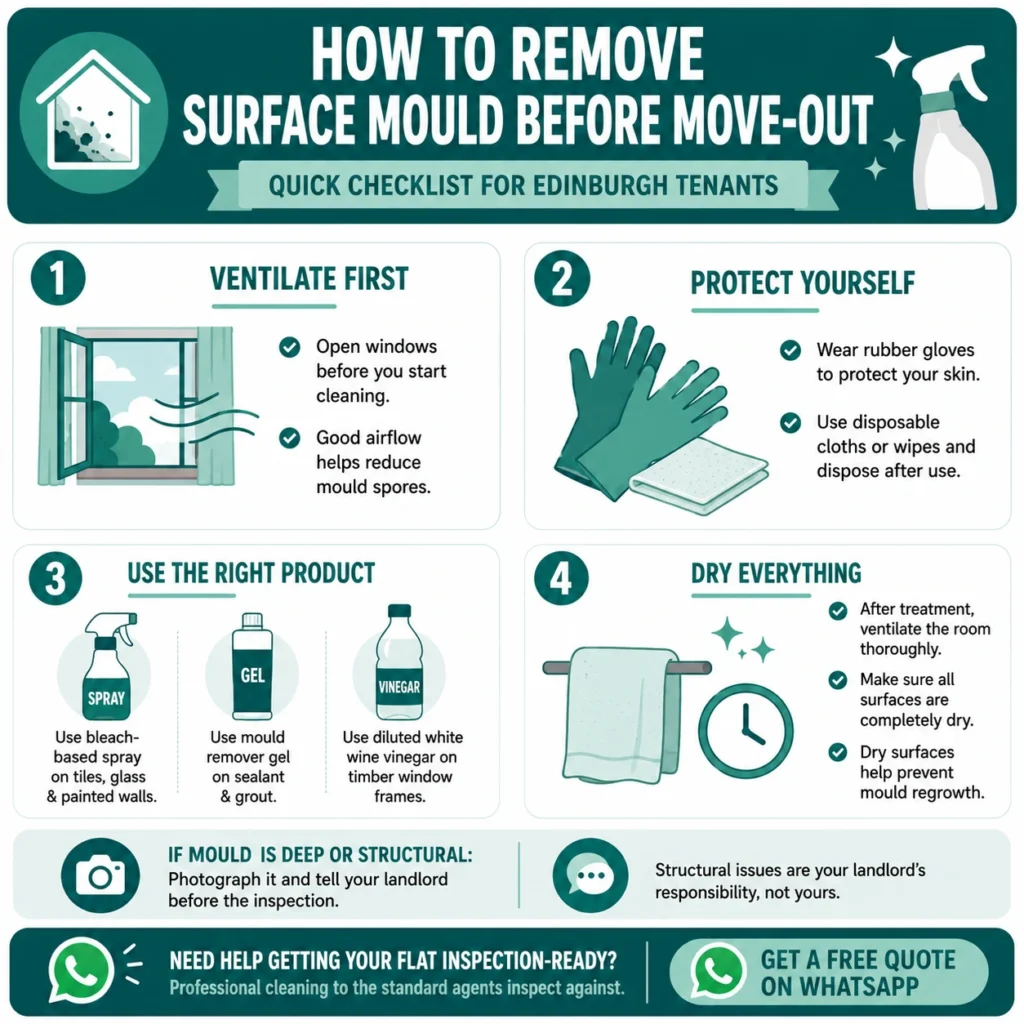
If the mould is surface level — sitting on tiles, window frames, sealant, or painted walls rather than embedded deep into plaster or brickwork — you can usually deal with it before inspection.
If the mould is extensive, deeply embedded in plaster, or clearly caused by a structural issue, surface treatment will not fully solve it. Document it and contact your landlord before inspection.
Where MT Cleaners fits in
A professional end of tenancy clean covers the surface-level mould that accumulates in bathrooms and on window frames as part of the standard service.
Our end of tenancy cleaning across Edinburgh works to the exact standard letting agents inspect against.
Kitchen
- Oven, hob, and extractor fan degreased and cleaned inside and out
- Fridge and freezer defrosted if needed and wiped down throughout
- All cupboards and drawers cleaned inside and out
- Sink and taps descaled and polished
- Worktops, splashbacks, and tiles scrubbed clean
- Dishwasher and washing machine seals and drums cleaned
Bathroom
- Toilet cleaned thoroughly including behind the cistern and under the rim
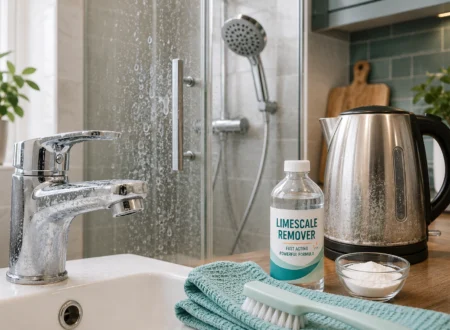
- Shower, bath, and taps with all limescale fully removed
- Tiles and grout scrubbed and rinsed
- Sink, mirror, and cabinet surfaces wiped down
- Extractor fan grilles cleaned
Bedrooms and living areas
- Skirting boards, window sills, and ledges dusted and wiped
- Inside wardrobes, drawers, and shelving cleaned out
- Light switches, plug sockets, and door handles wiped down
- Cobwebs removed from ceilings and corners
- Carpets and hard floors vacuumed and mopped
- Windows cleaned internally
We use eco-friendly products throughout, safe around children and pets. Fully insured. Fixed price agreed before we arrive.
| Property size | Starting price |
|---|---|
| Studio flat | From £90 |
| 1-bedroom flat | From £120 |
| 2-bedroom house | From £150 |
| 4-bedroom house | From £180 |
| 5-bedroom house or larger | From £200+ |
All prices are fixed and you will know the full cost before we arrive.
Get free quote on WhatsAppDocument everything before you leave
Whether you have treated the mould yourself or are flagging it as a pre-existing issue, photographs are your best protection.
Evidence taken at the right moment protects you in ways nothing else can.
How to book your end of tenancy clean
Send us a WhatsApp message with your property size and move-out date. We come back quickly, confirm your slot the same day, and show up when we said we would.
Visit mtcleaners.co.uk or tap the button below.
Need help before inspection day?
Tell us your property size and move-out date, and we will send you a clear fixed quote.
Get free quote on WhatsAppFAQs about how to remove mould before moving out Edinburgh
Is the landlord responsible for mould in Scotland?
Landlords are responsible for mould caused by structural problems like damp walls, faulty ventilation, or poor insulation. Surface mould linked to ventilation habits during the tenancy depends on the specific circumstances.
Can I refuse to pay rent if there is mould in the UK?
Withholding rent without following the correct legal process puts you at risk of breaching your tenancy agreement. Report the mould formally in writing and keep a record of the response.
What time of year is worst for mould?
October through February is usually the worst period for mould in Edinburgh flats because cold external temperatures and indoor heating increase condensation.
What kills black mould in the UK?
Bleach-based sprays are effective for black mould on tiles, glass, and painted walls. For sealant and grout, a dedicated mould remover gel usually works better.
What kills black mould immediately?
Bleach-based products work fastest on hard surfaces. White wine vinegar is gentler and safer on timber window frames, but it works more slowly.
What is the UK number one mould remover?
HG Mould Spray is widely regarded as one of the strongest options available. For bathroom sealant, gel-based products tend to work better than sprays.